

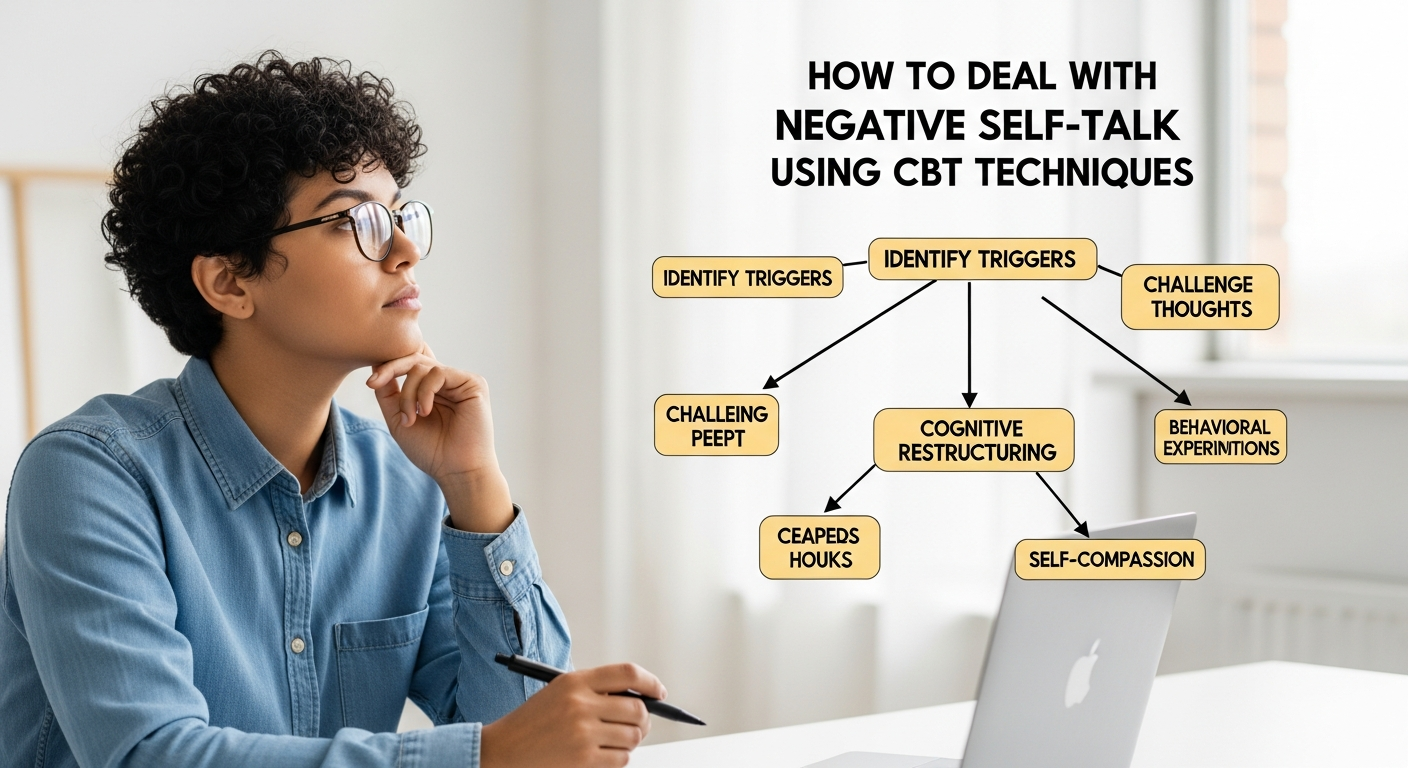
If you’ve ever caught your mind whispering things you’d never dare say to another human being, you already understand the power of negative self-talk. It sneaks in quietly—while brushing your teeth, scrolling your phone, or replaying a conversation for the tenth time—until those small internal comments begin to shape the way you view yourself. Many people experience it, often without realizing how much influence it holds. And at some point, you begin to wonder whether this inner critic is protecting you from mistakes or simply draining your confidence one thought at a time.
The truth is that negative self-talk behaves like an untrained narrator inside your mind. It jumps to conclusions, exaggerates small problems, and insists that worst-case scenarios are simply facts. But this narrator can be retrained—and that’s exactly where Cognitive Behavioral Therapy (CBT) becomes life-changing. Learning how to deal with negative self-talk using CBT techniques doesn’t just help you think differently; it helps you live differently. It reshapes emotional patterns, improves decision-making, and strengthens your overall health and wellness.
Most people believe their thoughts because thoughts sound like facts. If the mind says, “You always fail,” it feels like an observation, not a distortion. But psychology research from institutions such as Harvard Health consistently shows that negative thinking patterns often operate like shortcuts—fast, automatic, but deeply inaccurate.
One of the most common patterns is catastrophizing, the mental habit of predicting disaster even when evidence doesn’t point that way. Another is personalization, where neutral events feel like personal attacks. Someone doesn’t reply to a message? The internal narrative becomes, “They’re ignoring me because I’m not important.” Even if the real reason is simply that they were busy.
These patterns explain why negative self-talk can feel familiar, even comforting, because the mind prefers old pathways, even if they’re harmful. The goal of CBT is not to silence your thoughts but to teach you to question them—gently but firmly—until they lose their grip.
Imagine waking up late and missing an important work call. The moment you see the time, a quick wave of panic hits. Then the thoughts begin.
“I messed everything up again.”
“Why can’t I be disciplined like everyone else?”
“Today is ruined.”
This is a classic negative self-talk cycle. Instead of dealing with the situation, your mind leaps into criticism. Instead of looking for solutions, it attacks your abilities. What CBT teaches is that these automatic thoughts are the first place where psychological change can begin. Once you slow them down and examine them, they lose their authority.
CBT works on a simple but powerful principle: thoughts, emotions, and behaviors are connected. When you shift one, the others begin to change. By learning how to deal with negative self-talk using CBT techniques, you train your brain to identify distorted patterns and replace them with balanced, realistic thoughts.
This isn’t about forced positivity. It’s about accuracy. It’s about replacing “I always fail” with “I made a mistake, but I can fix it and learn from it.” The second version isn’t sugarcoating; it’s truthful, actionable, and empowering.
A university student named Lina struggled with exam anxiety. Even after scoring well throughout the semester, her mind repeated the same phrase before every test: “I’m not smart enough for this course.” Using CBT, she began writing down her recurring negative thoughts and labeling the distortions behind them. She realized that her mind was engaging in all-or-nothing thinking, assuming she must be either brilliant or incapable.
Over several weeks, she practiced reframing her thoughts into realistic statements supported by facts. Instead of “I’m not smart enough,” she shifted to, “I’ve been consistent, and I understand the material. Anxiety doesn’t define my ability.”
By exam season, her stress didn’t disappear completely, but her mindset became far more grounded. Her confidence grew because her thoughts were no longer fueled by fear, but by evidence.
A young project manager named Daniel carried perfectionism like a heavy backpack. Every mistake, no matter how small, became proof that he wasn’t good enough. CBT helped him identify his habit of magnification—treating minor issues as major failures.
Whenever he caught himself thinking, “I’m terrible at my job,” he practiced the CBT technique of examining the evidence.
Had he delivered successful projects before? Yes.
Did his team trust him? Absolutely.
Were small mistakes normal in a fast-paced environment? Without a doubt.
This practice didn’t just improve his emotional wellbeing; it transformed his productivity. He stopped wasting energy on internal criticism and began focusing on solutions and leadership.
CBT has been widely studied for decades, and institutions like the WHO and Mayo Clinic recognize it as a leading therapy method for managing anxiety, depression, self-esteem problems, and negative thinking. Research shows that CBT helps rewire neural pathways through a process known as cognitive restructuring, meaning your brain can learn to identify distortions faster and replace them with healthier patterns.
The process strengthens emotional regulation and reduces stress over time. That’s why integrating CBT techniques into your daily routine doesn’t just improve mental clarity—it improves your overall health and wellness.
One of the most effective ways to apply CBT is to catch your negative thoughts in real time. If you notice your inner critic becoming loud, pause for a moment and mentally step back. Ask yourself:
“Is this thought a fact, or is it a habit?”
The question itself creates distance between you and the negative narrative. It transforms the thought from a command into an observation. That small shift opens the door for clarity.
From there, CBT encourages you to examine the evidence behind your thought, consider alternative explanations, and form a more balanced conclusion. Over time, this becomes second nature.
Another powerful approach is adopting a tone of self-compassion. Imagine speaking to yourself as you would to a close friend. You wouldn’t tell a friend they’re worthless for being late, or undeserving for making a mistake. You’d encourage them, help them see the bigger picture, and remind them of their strengths.
Your inner voice deserves the same kindness.
This shift does not mean ignoring responsibility. It means approaching challenges with support instead of self-attack. When practiced consistently, the mind begins to respond in healthier ways. Stress levels decrease, clarity increases, and emotional balance improves.
As mental health awareness grows globally, CBT is evolving beyond traditional therapy rooms. Mobile apps, wearable stress monitors, online therapy tools, and AI-assisted mood trackers are making CBT techniques more accessible than ever. This trend will continue to expand, helping more people learn how to deal with negative self-talk using science-backed methods.
Researchers predict that digital CBT could become one of the most widely used wellness tools within the next decade, especially for people who prefer private, self-paced mental health support.
Managing negative self-talk isn’t a quick transformation. It’s a skill—one that strengthens with practice. The more you challenge your distorted thoughts, the weaker they become. The more you reframe your inner voice, the more confident and emotionally resilient you become.
Learning how to deal with negative self-talk using CBT techniques isn’t just beneficial for difficult days; it’s a lifelong investment in your well-being. Whether you’re facing stress, decision overwhelm, relationship conflicts, or major transitions, CBT offers tools that adapt to your situation and support your growth.
Your mind may still whisper discouraging thoughts from time to time, but with training, those whispers lose their authority. You gain the clarity to choose which thoughts deserve your attention.
The journey to transforming your inner voice starts with awareness. Every negative thought you catch is an opportunity to rewrite the narrative. Every reframed belief strengthens emotional resilience. And every CBT technique you use brings you one step closer to a more balanced, confident version of yourself.
Your mental wellness is shaped not by perfection, but by practice. Begin with one thought, one moment of reflection, one gentle challenge to the inner critic. Over time, the voice that once held you back becomes quieter, and a new voice—supportive, grounded, and empowering—begins to take its place.
To deepen your journey in mental clarity and emotional wellbeing, explore more of our wellness guides on TheGangchil.com. Your health and wellness story is ongoing, and the tools you choose today can shape the entire path ahead.
Posted 7:28 pm | Monday, 01 December 2025
| nm