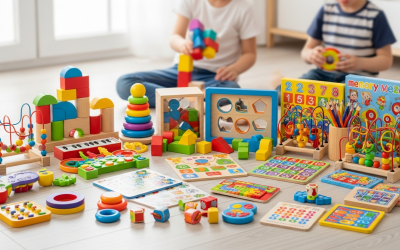


One afternoon in Nairobi, a young mother named Amira watched her three-year-old son stack wooden blocks with quiet determination. She noticed how his hands moved carefully, how his eyes followed each piece, and how he celebrated small victories with glowing pride. At first, she had thought of toys as mere distractions, but that single moment changed her understanding completely. Those wooden blocks weren’t simply pieces of painted wood; they were shaping his motor skills, attention span, confidence, and creativity.
Across the world in Toronto, a father named Lucas faced a different story. His daughter had a basket full of electronic toys with flashing lights and quick tunes, yet they left her restless and overwhelmed. When he replaced them with simple, open-ended toys—clay, puzzles, shape sorters, and pretend-play kits—he noticed her focus improving in just two weeks. The change was subtle at first, but gradually her storytelling, social interaction, and emotional expression grew stronger.
Stories like these explain why the conversation around the best learning toys for child development has become essential for families, educators, and health professionals worldwide. Toys are not just entertainment; they are tools that help build cognitive strength, emotional wisdom, social skills, language growth, and problem-solving abilities. In a world where screens often dominate childhood, the right learning toys act as emotional anchors and developmental catalysts.
Child development specialists often say that play is a child’s earliest form of work. According to the World Health Organization, early stimulation through play dramatically influences brain architecture during the first five years. This is the period when neural connections form at the astonishing rate of one million per second. When children explore shapes, textures, sounds, and patterns through toys, their brains strengthen these pathways for future skills in math, language, and emotional intelligence.
Imagine a toddler playing with a simple shape puzzle. The process looks ordinary, yet it activates visual perception, hand–eye coordination, memory formation, and spatial reasoning. A mini calculation can help show the scale: if a child spends just fifteen focused minutes a day with a developmentally appropriate toy, that becomes over ninety hours of structured stimulation per year. Ninety hours of growth, independent discovery, and silent cognitive strengthening.
This is why learning toys matter globally. In communities with limited educational resources, toys often serve as early learning tools that bridge the developmental gap. In wealthier households, they help counter digital overload by bringing back hands-on, imaginative play. No matter the region or socioeconomic background, the right toys help children learn how to think, feel, explore, and understand the world.
The term “best” does not mean expensive or technologically advanced. It means toys that nurture the most important aspects of child development, including creativity, problem-solving, emotional expression, sensory understanding, and communication.
A developmental psychologist once explained that the most effective toys offer possibilities instead of outcomes. They allow multiple uses, adapt to different ages, and encourage active thinking. For example, building blocks never go out of style because they support cognitive growth at age two and engineering concepts at age seven.
Real-world examples highlight the difference clearly. A family in Bangkok introduced their preschooler to a set of magnetic tiles and noticed how he started creating houses, bridges, and animals. Over time, his storytelling abilities strengthened as he described what he built. In contrast, their younger daughter received a mechanical toy that performed fixed actions. She lost interest within a week because it didn’t allow creativity or choice. Their experience showed that toys allowing imagination last longer in a child’s mental landscape.
Children experience the world through their senses. Toys with interesting textures, sounds, weights, and movements activate multisensory learning. A soft rattle enhances auditory tracking, a textured ball increases tactile awareness, and modeling clay strengthens finger muscles while teaching cause-and-effect relationships.
Pediatric therapists often say that children who engage in regular sensory play throughout early childhood show better emotional regulation and improved learning readiness. A small case study from a children’s therapy center in Melbourne revealed that children who used sensory toys for twenty minutes daily over twelve weeks showed noticeable improvements in calmness and attention span.
The link between sensory exploration and cognitive growth is not accidental. Neuroscience research from Harvard shows that repeated sensory experiences help the brain organize information more efficiently, which supports early reading and problem-solving skills.
Toys that encourage pretend play, role-play, and interactive scenarios build emotional intelligence and social awareness. When a child uses a toy doctor kit to treat a teddy bear, they practice empathy, communication, and scenario-based thinking. These skills are essential for emotional maturity.
A teacher from Dubai shared a memorable experience about a shy student who rarely participated in class. When the school introduced storytelling puppets, the child slowly began expressing thoughts and emotions through the puppet characters. Within a few months, he became more confident speaking in front of classmates. The toy served as a safe emotional bridge.
Healthy emotional development also influences behavior. Children who play with cooperative toys often learn patience, sharing, and conflict resolution naturally. This becomes especially important in multicultural environments where children are exposed to diverse social interactions.
Cognitive development grows through curiosity, exploration, and problem-solving. Puzzles, STEM kits, construction sets, and logic games activate multiple cognitive processes simultaneously.
A mini calculation can illustrate the impact. If a child completes a ten-piece puzzle daily, that is over three thousand problem-solving moments in a year. These moments add up, shaping patterns of persistence, critical thinking, and learning flexibility.
Researchers at Mayo Clinic emphasize that cognitive toys help children understand sequencing, patterns, spatial logic, and memory. These skills form the foundation of future academic success. Learning toys essentially act as early brain-training tools, preparing children for school and lifelong learning.
Children learn language not only by listening but also by interacting. Toys such as picture books, storytelling sets, puppets, and role-play items encourage expressive communication. When children explain what they are doing, name objects, or invent stories, they practice vocabulary, sentence formation, and narrative thinking.
A speech therapist in the UK described a case where a toddler with delayed speech made faster progress when his parents introduced toys that demanded verbal interaction. They replaced silent toys with puppets and storytelling flashcards, and within weeks, he began naming characters and describing actions. His progress came from the simple fact that the toys required speech to complete the play.
According to the CDC, early language stimulation is one of the strongest predictors of academic readiness. Toys that inspire storytelling, conversation, or pretend-play naturally elevate language growth.
Gross motor toys such as ride-ons, balance bikes, push toys, and soft climbing structures help children develop strength, balance, coordination, and body awareness. Fine motor toys like threading sets, beads, tweezers, and pegboards strengthen finger muscles needed for writing and daily activities.
Parents sometimes wonder why writing skills appear delayed even when children seem otherwise advanced. Developmental experts explain that fine motor development happens gradually. A child who plays regularly with clay or stacking toys will find it easier to grip pencils later on.
Physical development through toys not only supports health but also influences confidence. A boy in Malaysia gained notable self-esteem after mastering a simple balancing beam toy. His teacher observed that physical confidence soon translated into academic confidence as well.
The future of educational toys is moving toward sustainability, neuroscience-informed design, and screen-free creativity. Wooden toys are making a comeback due to their open-ended potential, durability, and environmental benefits. Interactive STEM kits with real-world applications are gaining popularity globally.
Analysts predict that smart toys will evolve, but parents will increasingly prefer toys that allow exploration instead of passive consumption. The balance between technology and imagination will define the next decade of child development.
Another powerful trend is the rise of culturally inclusive toys. Children learn empathy and global awareness when they see toys reflecting different ethnicities, cultures, and abilities. This shift is aligning with global diversity values and psychological research supporting identity-sensitive play.
In a world shaped by rapid technology and shifting family routines, finding the best learning toys for child development is not just about choosing the trendiest products. It is about understanding how play shapes the brain, emotions, language, creativity, and social intelligence. The right toys nurture curiosity, emotional resilience, cognitive sharpness, and physical confidence—qualities every child needs for a healthy future.
Parents, educators, and caregivers have a unique opportunity to shape early development through thoughtful play. Choosing toys that encourage imagination, problem-solving, movement, and communication can transform a child’s daily life and future potential.
Readers seeking more wellness insights, evidence-based parenting advice, and developmental guidance can explore additional resources at TheGangchil, where child wellness topics are broken down into clear, practical, and globally relevant explanations.
1. What makes a toy a “learning toy”?
A learning toy encourages exploration, creativity, problem-solving, or skill-building instead of passive entertainment.
2. At what age should children start using learning toys?
From birth onward, as each developmental stage benefits from age-appropriate sensory and cognitive stimulation.
3. Do expensive toys work better for development?
Not necessarily. Open-ended, simple, and imaginative toys often support development more effectively than high-tech, expensive toys.
4. How many learning toys does a child need?
Quality matters more than quantity. A small selection of well-chosen toys can support long-term healthy development.
Posted 9:20 pm | Tuesday, 02 December 2025
TheGangchil | nm