
A reflective guide for anyone navigating burnout, anxiety, and the search for a calmer, more conscious way to live.
There is a particular kind of exhaustion that doesn’t come from overwork alone. It settles in slowly — in the late-night scrolling, the chemical-heavy candles you light to “unwind,” the synthetic supplements you grab from a crowded shelf without really reading the label. For many people, the products meant to help them relax are quietly adding to the very load they are trying to shed.
That is why knowing how to choose eco-friendly wellness products for stress relief has become more than a lifestyle preference. It has become, for a growing number of people worldwide, a genuine act of mental health care.
This is not about perfection or expensive minimalist aesthetics. It is about making small, informed decisions — decisions that support your nervous system, reduce your toxic load, and happen to be gentler on the planet at the same time. The two goals, it turns out, are rarely in conflict.
According to the World Health Organization, mental health conditions affect one in eight people globally, and stress is among the most common contributing factors. Yet most mainstream wellness products are formulated with synthetic fragrances, endocrine-disrupting plastics, and preservatives that research is beginning to link with increased anxiety and hormonal disruption. The problem, in other words, is built right into many of the solutions being sold.
So let’s slow down, think carefully, and find a better path.
Walk through any pharmacy or wellness store and you will find rows of bath soaks, aromatherapy candles, herbal supplements, and “calming” sprays. Most of them carry some version of the word “natural” on the label. Many of them are not.
The U.S. Food and Drug Administration does not regulate the term “natural” in cosmetics or wellness products, which means a candle labeled “natural lavender” can contain synthetic fragrance compounds called phthalates. These compounds, commonly used to help scents linger, have been associated in several studies with increased cortisol levels — the primary stress hormone the product is supposed to lower.
Similarly, many stress-relief supplements sold over the counter contain fillers, artificial colorings, and poorly sourced herbal extracts that provide little therapeutic value. A 2020 review published in the journal Nutrients found that product quality varied so significantly across commercial herbal stress supplements that standardized dosing was nearly impossible.
Beyond the physical ingredients, there is also the psychological toll of disposability. When a plastic diffuser breaks after six months, or a single-use bath bomb wrapper goes straight to landfill, the mental friction of that waste — however subtle — registers. Research in environmental psychology suggests that people who feel guilty about their consumption habits report higher baseline anxiety than those who feel their choices align with their values.
The conventional wellness market, in short, has a gap. It sells relief without considering the full cost of delivering it.
Before we discuss how to choose eco-friendly wellness products for stress relief, it helps to be precise about the term. “Eco-friendly” is not a certification, a regulatory standard, or a guarantee. It is a direction — and the market, unfortunately, has learned to exploit the aesthetic of that direction without always following its substance.
Greenwashing — the practice of making a product appear more sustainable than it is — is rampant in the wellness space. A bamboo-wrapped plastic bottle is still a plastic bottle. An “organic” essential oil diluted in synthetic carrier oil provides very little of the benefit the label implies. Awareness of these gaps is not cynicism; it is a form of self-protection.
Genuinely eco-friendly wellness products tend to share a few honest characteristics. Their ingredients are traceable, meaning you can find out where the lavender was grown or how the beeswax was sourced. Their packaging is minimal, recyclable, or refillable. They are made in small or mid-scale batches under ethical labor conditions. And they do not rely on synthetic fragrances, parabens, or petroleum-derived ingredients to achieve their effect.
For the purposes of stress relief specifically, the goal is products that work with your body’s natural chemistry — not against it. That distinction matters more than any particular brand or certification symbol.
Choosing well does not require a degree in chemistry or an unlimited budget. It requires a few reliable questions applied consistently.
Start with the ingredient list, not the label. Flip the product over before you read the front. The ingredient list tells you what you are actually buying. Look for recognizable botanical names — Lavandula angustifolia rather than “lavender fragrance,” for instance. Short ingredient lists are generally a good sign. The presence of “parfum” or “fragrance” as a catch-all term is often a red flag.
Research the brand’s sourcing practices. Many small and mid-size eco-wellness brands now publish their supply chain information on their websites. If that information is completely absent, it is worth asking why. Brands with nothing to hide tend to share where their ingredients come from and how their workers are compensated.
Check for credible third-party certifications. While no single label guarantees perfection, certifications such as USDA Organic, EWG Verified, COSMOS Natural, or Leaping Bunny (cruelty-free) indicate that an independent body has assessed the product against specific standards. These are imperfect but meaningful.
Consider the packaging honestly. Glass, aluminum, and paper are generally more recyclable than most plastics. Refillable systems — particularly for things like diffuser oils or body butters — reduce waste significantly over time. Some brands now offer packaging take-back programs, which is worth noting.
Ask whether the product actually works. An eco-friendly product that does not relieve stress is not serving its core purpose. Look for products with transparent dosage information, and where relevant, consult published clinical research. Ashwagandha, for example, has considerably more peer-reviewed evidence supporting its stress-reducing effects than most other herbal adaptogens currently on the market.
Different stress profiles call for different types of support. The following categories offer a starting point — not a shopping list, but a map of what exists and what to look for within each.
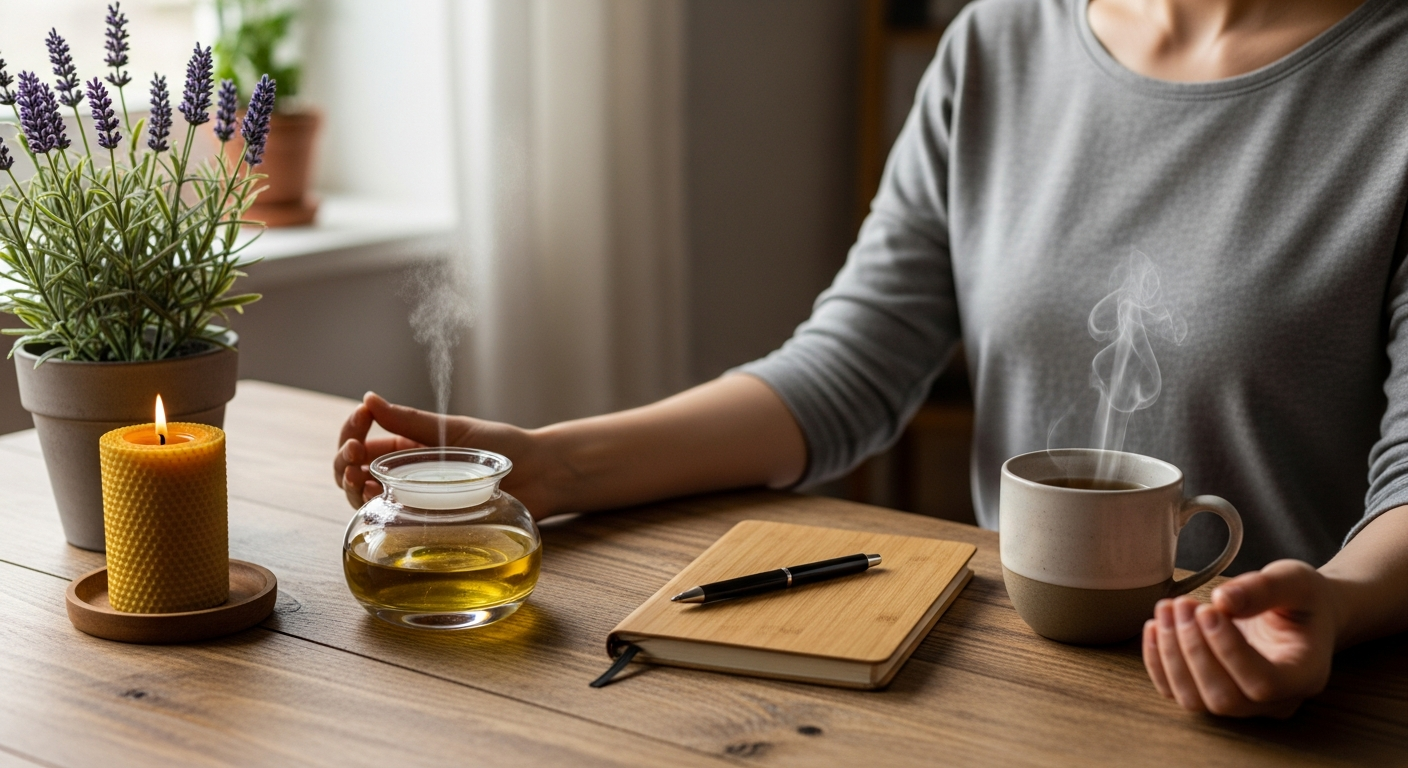
Aromatherapy and Essential Oils. Pure essential oils — not fragrance oils — have a reasonably well-documented relationship with the nervous system. Lavender, in particular, has been studied in clinical settings for its calming effects on the autonomic nervous system. When choosing an essential oil, look for GC/MS (gas chromatography/mass spectrometry) testing data, which confirms purity. Diffusers made of ceramic or glass are preferable to plastic ultrasonic models, both for longevity and for avoiding potential off-gassing.
Herbal Teas and Adaptogens. Loose-leaf teas in compostable packaging represent one of the simplest sustainable wellness choices available. Chamomile, lemon balm, and passionflower have documented anxiolytic properties. For those exploring adaptogens, ashwagandha (Withania somnifera) and rhodiola (Rhodiola rosea) have accumulated the most credible clinical evidence. Always check for organic certification and transparent country-of-origin labeling.
Journaling and Analog Mindfulness Tools. A recycled-paper journal, a wooden pen, or a simple sand timer for breathwork sessions — these are often overlooked in conversations about wellness products, but they may be among the most effective. Research from Harvard Health Publishing has consistently found that expressive writing reduces stress markers, including cortisol levels, in both short and long-term studies. The environmental footprint here is minimal.
Natural Skincare with Stress-Relief Benefits. Magnesium-rich topical products — such as magnesium flakes for bath soaks or magnesium body butters — are gaining attention in integrative health circles. While the evidence for transdermal magnesium absorption is still debated, magnesium deficiency is well-established as a factor in heightened stress reactivity, and many people report subjective benefits from these products. Choose options packaged in glass or aluminum and formulated without synthetic fragrances.
Weighted Blankets Made with Natural Materials. Weighted blankets have a respectable body of research supporting their use in reducing anxiety and improving sleep quality. Look for versions made with organic cotton or linen covers and glass bead or natural grain filling rather than plastic pellets. These tend to be more breathable, more durable, and considerably easier to recycle at end of life.
It helps, sometimes, to put a human face on this. Consider the experience of a mid-career teacher in the UK who began experiencing what her GP described as generalized anxiety in her late thirties. Rather than beginning with medication immediately, she worked with an integrative health counselor who suggested a trial of several eco-conscious lifestyle changes — including swapping synthetic air fresheners for a simple diffuser with certified organic lavender oil, replacing her nightly wine habit with an herbal tea blend, and introducing a ten-minute journaling practice.
Three months later, she reported measurable improvements in sleep quality and a subjective reduction in what she called “background worry.” Her story is not a clinical trial. But it reflects a pattern that practitioners in integrative medicine encounter regularly: when people reduce their synthetic chemical exposure and introduce evidence-informed botanical support, many experience a quieting of the nervous system that had eluded them despite years of conventional approaches.
A 2021 randomized controlled trial published in Medicine found that participants who used lavender essential oil aromatherapy for four weeks showed significantly reduced scores on the Hamilton Anxiety Rating Scale compared to a control group. The effect size was modest but consistent across demographics — suggesting that while aromatherapy is not a standalone treatment for clinical anxiety, it may be a genuinely useful component of a broader mental health strategy.
For many people, that is precisely the point. These are not replacements for therapy or medical care. They are thoughtful complements — small signals to the nervous system that safety and ease are possible.
Getting this wrong is surprisingly easy, especially when anxiety is high and marketing is sophisticated. A few patterns tend to trip people up most often.
Don’t confuse price with quality. Expensive does not mean clean. Some of the most synthetic, poorly sourced products in the wellness industry come in beautiful packaging at premium prices. Conversely, some of the most effective, genuinely natural products are produced by small makers and are priced very modestly.
Don’t fall for ingredient theater. Some brands list a single “hero” botanical in their product name while burying it at the very end of the ingredient list — meaning it is present in trace amounts too small to have any real effect. Learn to read the full ingredient list in order; ingredients are listed by concentration, highest to lowest.
Don’t self-treat serious mental health conditions. Eco-friendly wellness products can be a meaningful part of a self-care routine, but they are not substitutes for professional mental health support. If you are experiencing persistent depression, panic disorder, PTSD, or thoughts of self-harm, please speak with a qualified healthcare provider. The products discussed here are supportive tools, not clinical interventions.
Don’t buy more than you will use. One of the most common patterns in the wellness product space is accumulation — buying twelve products and using two. This is wasteful and often counterproductive, adding a layer of guilt and clutter that does not serve mental health. Start with one or two carefully chosen items and assess their effect before expanding.
For more guidance on building a sustainable self-care routine, see: Natural Self-Care Routines That Support Mental Wellness.
Sustainable wellness does not exist in isolation. It tends to work best when embedded in a broader approach to healthy living — one that includes movement, community, meaningful work, and quality sleep. The products you choose are simply one layer of a much larger ecosystem.
If you are new to eco-conscious living, it can help to read about others who have made this transition gradually. The journey is rarely linear, and the goal is not an idealized “green” identity. It is a slow, honest reorientation toward choices that feel better — for you and for the world you share with others.
You may also find it useful to explore how stress affects physical health and what holistic approaches can help. Understanding the mind-body connection can make the logic behind eco-friendly self-care feel less like a trend and more like common sense.
The goal is not to eliminate all synthetic products overnight, nor to become a perfect consumer. It is simply to become a more informed one — to bring a little more intention to the question of what you allow into your home, onto your skin, and into your nervous system.
There is a line between everyday stress — the kind that responds well to a walk outside, a cup of chamomile tea, or a slow morning routine — and stress that has become a clinical concern. It is worth knowing where that line tends to fall.
Consider speaking with a healthcare professional if your stress or anxiety is affecting your ability to work, maintain relationships, or care for yourself. Physical symptoms such as chronic insomnia, persistent headaches, heart palpitations, or digestive disruption can all be signs that your nervous system needs more support than self-care alone can provide.
Integrative medicine practitioners and licensed therapists who work within a holistic framework can often help you determine which eco-friendly or natural interventions are appropriate alongside any medical support you may need. This is not an either/or conversation — it is a both/and one, and a good clinician will treat it that way.
A note of caution on herbal supplements specifically: even natural compounds can interact with prescription medications. Ashwagandha, for example, may affect thyroid hormone levels and should be used with care by those on thyroid medication. St. John’s Wort has well-documented interactions with antidepressants, contraceptives, and several other drugs. Always disclose supplement use to your prescribing physician.
There is something quietly radical about choosing a beeswax candle over a synthetic one, or a glass-bottled herbal tincture over a plastic-packaged supplement. Not because it saves the world in a single gesture, but because it represents a shift in how you engage with the things that are supposed to take care of you.
Knowing how to choose eco-friendly wellness products for stress relief is, at its core, an act of discernment. It means slowing down in a market that profits from speed and impulse. It means asking questions in a space that prefers you buy first and read labels never. And it means treating your mental health as something deserving of the same care and honesty that you might bring to any other important decision.
That shift does not have to happen overnight. One considered swap — one product exchanged for a cleaner, more honest version — is a beginning. And beginnings, as most people who have found their way through burnout will tell you, are where everything important starts.
We’d love to hear from you. Have you made a switch to more eco-conscious wellness products? Has it changed how you feel — physically, mentally, or otherwise? Share your experience in the comments below. Real stories from real people are among the most useful resources any of us has.
Q: Are eco-friendly wellness products actually effective for stress relief, or is it just marketing?
A: Many are genuinely effective — but the key is choosing evidence-informed products rather than buying into branding. Lavender essential oil, chamomile tea, organic magnesium products, and adaptogenic herbs like ashwagandha have published clinical research supporting their use. The “eco-friendly” dimension matters because cleaner formulations reduce chemical stressors on the body, which may enhance — rather than undermine — the calming effect.
Q: How do I know if a wellness product is genuinely natural or just greenwashed?
A: Read the full ingredient list, not the front label. Look for recognizable botanical names, short formulations, and the absence of “parfum,””fragrance,” parabens, phthalates, and petroleum derivatives. Third-party certifications (USDA Organic, EWG Verified, COSMOS Natural) add an additional layer of accountability, though no single label is a guarantee.
Q: Can eco-friendly wellness products replace therapy or medication for mental health conditions?
A: No. These products can be meaningful complements to professional care, but they are not clinical interventions. If you are experiencing persistent anxiety, depression, or other mental health conditions, please consult a qualified healthcare provider. Self-care products work best as part of a broader, professionally guided mental health strategy.
Q: Are herbal supplements safe for everyone?
A: Not necessarily. Several herbal supplements interact with prescription medications and may be contraindicated in certain health conditions. Ashwagandha may affect thyroid function; St. John’s Wort has documented interactions with antidepressants, contraceptives, and other drugs. Always consult your prescribing physician before adding any supplement to your routine.
Q: Where is the best place to find trustworthy eco-friendly wellness brands?
A: The EWG’s Skin Deep database (ewg.org) allows you to search individual products and ingredients for safety ratings. The Good Trade and The Eco Hub are editorially independent platforms that research and recommend sustainable wellness brands. When in doubt, independent third-party reviews and ingredient verification are more reliable than branded marketing.
Posted 9:45 pm | Saturday, 28 February 2026
| nm